
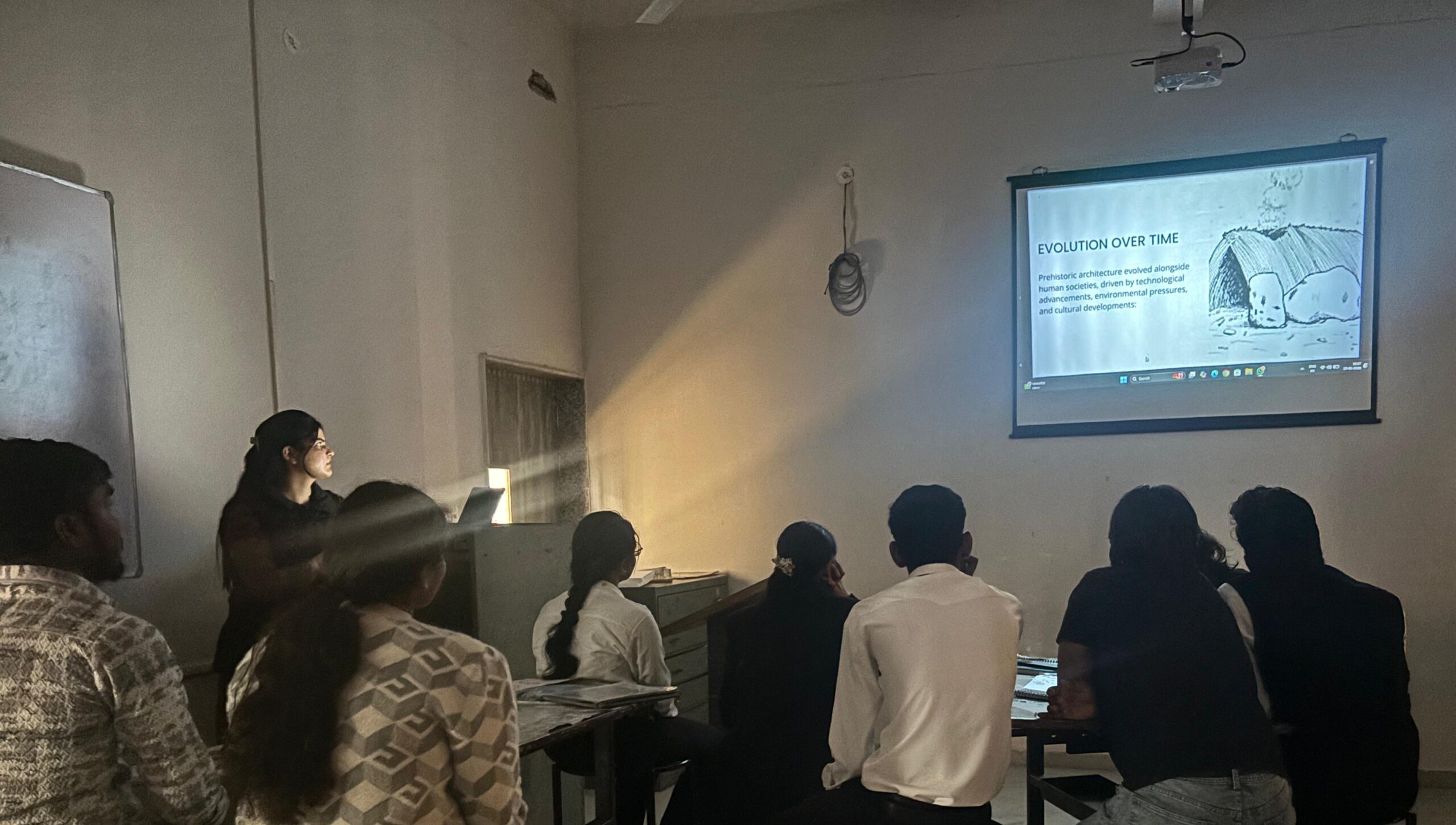
Enriching Session on Prehistoric Architecture Conducted for B.Arch First Year Students
The students of Bachelor of Architecture (First Year) recently attended an insightful and enriching academic session on Prehistoric Architecture, conducted by their subject faculty, Ar. Sana Malik. The session aimed to introduce young architecture students to the origins of built forms and the evolution of early human shelters, laying a strong foundation for their understanding of architectural history.
The lecture explored how prehistoric communities designed and constructed structures using locally available materials such as stone, mud, timber, animal skins, and thatch. They were explained how early humans responded to climate, geography, safety, and social needs while developing shelters. The discussion covered various examples including caves, rock-cut dwellings, megalithic structures, stone circles, and primitive hut forms. Students were particularly fascinated by how ancient builders achieved structural stability and durability without the advanced tools and technology available today.
Through visual presentations and diagrams, the session illustrated how prehistoric architecture was deeply connected to nature and survival. The concept of post-and-lintel construction, corbelling techniques, and the use of massive stone blocks in monuments like Stonehenge were discussed in detail. Emphasis was laid on understanding architecture as a response to human needs, environment, and available resources — a principle that remains relevant even in contemporary design.
Students encouraged to analyze prehistoric structures not merely as historical remnants but as intelligent design solutions rooted in simplicity and sustainability. She highlighted how the study of early architecture helps in developing sensitivity towards climate-responsive design and the importance of material honesty. The interactive session also included question-and-answer discussions, where students actively participated and shared their interpretations. The enthusiasm among the first-year students reflected their growing curiosity about architectural evolution and its relevance to modern practice.
The session proved to be both informative and inspiring, strengthening the academic journey of the budding architects. It provided them with a deeper appreciation of how architecture began as a basic human necessity and gradually evolved into a sophisticated discipline. Such engaging lectures continue to enhance the learning experience of the students and contribute significantly to their foundational knowledge in architecture.